


Fast, Reliable Spray Foam Insulation Across Lakeland Village
Spray foam insulation in Lakeland Village addresses two realities most local homeowners know too well: attic temperatures that climb past 150°F in July and August, and lake-driven humidity that works its way into crawlspaces along the shore. We install open-cell and closed-cell foam from Icynene and Demilec, matched to where your home actually loses energy. If you’re calling from Grand Avenue, Lakeside Drive, or the tract streets off Grand, we’ll have a crew to you quickly. Call (877) 265-0627 for a free estimate.
The right foam for a 1962 lake cottage is often different from the right foam for a 1988 stucco tract home up the hill. We’ve worked both. Nolan Pressler built Gallant Insulation Co around a simple rule: recommend the material that performs, not the one sitting on the truck.
Key Takeaways:
- Closed-cell spray foam runs $2.80 – $4.50 per board foot installed in Lakeland Village; open-cell runs $1.10 – $2.00.
- Homes near the shoreline need closed-cell and vapor barrier work more often than homes in Wildomar due to the high water table.
- We carry both Icynene and Demilec systems, so open-cell and closed-cell specs come from the same contractor.
- Free estimates. Licensed and insured. Call (877) 265-0627.
Why Gallant Insulation Co Is Lakeland Village’s Preferred Spray Foam Insulation Company
We’ve crawled under enough 1970s lakefront cottages in Lakeland Village to know what the high water table does to insulation. That local repetition matters. It means we show up already understanding that pier-and-beam crawlspaces off Lakeshore Drive often carry moisture that drier inland jobs never see, and we spec closed-cell foam accordingly.
Lakeland Village homeowners tell us they appreciate that the recommendation doesn’t shift based on what’s loaded on the truck. Gallant carries eight manufacturer brands across three installation methods. If your attic needs open-cell and your rim joists need closed-cell, we don’t have to call another contractor or talk you into a compromise.
Response time to most of the 92530 zip is same-day or next-day for estimates. For emergency work, like wet insulation after a storm or a punctured roof deck, call (877) 265-0627 and we’ll get someone out fast.
Written by Nolan Pressler, Owner at Gallant Insulation Co, serving Lakeland Village and surrounding Riverside County communities.
Closed Cell Spray Foam Insulation in Lakeland Village
Closed Cell Spray Foam Insulation in Lakeland Village runs $2.80 – $4.50 per board foot installed, and for lakefront homes on a high water table it’s often the specification that prevents mold and delamination down the road. Closed-cell foam cures rigid, adds structural racking strength, and acts as a vapor barrier at roughly 2 inches thick. That last part is the reason it gets specified so often here: when moisture wicks up through piers and into band joists, open-cell can’t stop it and fiberglass just absorbs it. Closed-cell does the job.
Crawlspace and Rim Joist Sealing
The rim joist and band area is where water vapor enters most Lakeland Village crawlspaces. We apply closed-cell foam to the band and at least 2 inches to the rim, which air-seals the cavity and stops humid lake air from condensing on framing. This is also the area where we most often find the original fiberglass batts in 1960s-1980s homes sagging or falling out entirely.
Storm and Wind Resistance
Lakeland Village sees strong winds off Lake Elsinore, especially in fall and winter. Closed-cell foam’s structural bond adds shear strength to wall assemblies and roof decks, which helps resist wind-driven rain penetration. When installed to the underside of the roof deck, it also creates a secondary water barrier if shingles lift in a wind event.
Open Cell Spray Foam in Lakeland Village
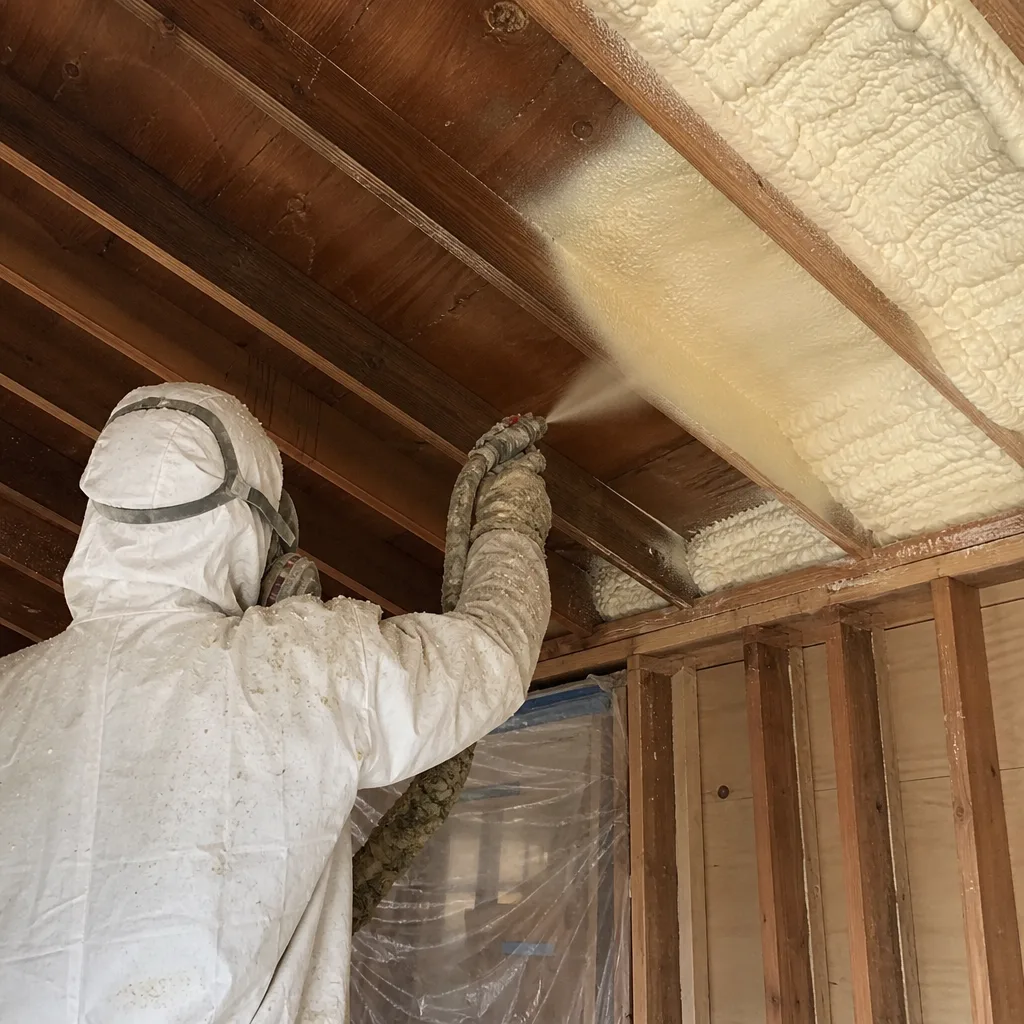
Open Cell Spray Foam in Lakeland Village typically runs $1.10 – $2.00 per board foot installed. It’s an air-sealing specialist: it expands to fill cavities completely and stops the stack effect that pulls 150°F attic air into living spaces during summer. For attics, exterior walls over stucco, and interior partitions where noise reduction matters, open-cell is often the right call. It breathes more than closed-cell, which means it should not be used below grade or in areas with constant moisture contact.
Attic Roof Deck Insulation
In Lakeland Village’s 1980s tract homes, attics routinely spike above 150°F in August. Open-cell applied to the roof deck brings the attic into the conditioned envelope, dropping ridge vent temps and reducing the cooling load on the rest of the house. Pair it with a radiant barrier on the roof deck in homes with asphalt shingle roofs and the difference is measurable within days.
Interior Wall Sound Dampening
Homes packed close together along Grand Avenue and Lakeside Drive benefit from open-cell’s acoustic performance. It knocks down road noise and neighbor noise more effectively than batt insulation, which is one reason we spec it in shared-wall assemblies and bedroom partitions throughout the 92530 zip.
Trusted Brands We Service in Lakeland Village
Gallant Insulation Co installs both Icynene and Demilec spray foam systems, which means we’re not locked into a single formulation. Icynene’s open-cell product is a workhorse for attic and wall cavities. Demilec’s closed-cell lineup handles the moisture and structural demands of lakefront crawlspaces. Beyond foam, we also stock Rockwool and CertainTeed products for hybrid projects where batts or mineral wool belong in part of the assembly. Every material on our truck comes from a named manufacturer with a written warranty. No off-brand, no unbranded drums.
Common Spray Foam Insulation Problems We See in Lakeland Village Homes
- Attic heat degrading open-cell foam. Attics that regularly spike above 150°F can cause open-cell foam to lose R-value over time if ventilation is poor. We see this most in 1980s tract homes with original ridge and eave venting that’s been partially blocked by debris.
- Crawlspace moisture causing delamination. Lake-driven humidity and the high water table push vapor into crawlspaces along Lakeshore Drive and Grand Avenue. Without a proper vapor barrier, closed-cell foam can delaminate from framing, and mold forms behind it.
- Knob-and-tube wiring encapsulation. 1960s wood-frame homes in Lakeland Village sometimes still have knob-and-tube runs in attic cavities. Spray foam applied directly over live knob-and-tube can trap heat and create a fire risk. Those circuits need to be rewired or isolated before we foam.
- Sagging original R-11 batts. Many 1960s-1970s homes still carry the original R-11 or R-13 batts, which have sagged, compressed, or fallen away from the ceiling. When we remove those and replace with spray foam, homeowners notice the difference in room temperature almost immediately.
Pricing for Spray Foam Insulation in Lakeland Village, CA
Open-cell spray foam in Lakeland Village runs $1.10 – $2.00 per board foot installed, while closed-cell runs $2.80 – $4.50 per board foot. A typical 1,200 – 1,500 square foot attic roof deck using open-cell lands between $4,500 and $7,500 total. Closed-cell on a lakefront crawlspace and rim joist area generally runs $3,000 – $6,000 depending on access and how much surface area needs sealing. Job complexity, existing insulation removal, and whether electrical work is needed all affect the final number. We give a written estimate before any work starts, and the price doesn’t change unless the scope does. Call (877) 265-0627 to schedule a free on-site quote.
Line-item ranges for Lakeland Village:
- Open-cell attic roof deck: $4,500 – $7,500 for 1,200 – 1,500 sq ft
- Closed-cell crawlspace and rim joist: $3,000 – $6,000
- Closed-cell garage ceiling: $1,800 – $3,200
- Hybrid project (foam + Rockwool): $6,000 – $12,000+ depending on scope
We Also Serve Cities Near Lakeland Village
Our Spray Foam Insulation crews work throughout the Lake Elsinore basin. If you’re in Sedco Hills, Canyon Lake, Meadowbrook, or Wildomar, the same team that handles Lakeland Village’s lakefront crawlspaces can handle your project. Wildomar homes, being drier and farther from the water table, often need less vapor barrier work, but the same closed-cell spec applies anywhere moisture is a concern. Call (877) 265-0627 for service in any nearby community.
Serving Lakeland Village, CA — Our Local Coverage Area
We’re based in the Lakeland Village area and know this community well. Use the map below to see our service coverage — if you’re nearby, we can almost certainly help.
FAQs About Spray Foam Insulation in Lakeland Village
Yes. Closed-cell spray foam applied to roof decks and exterior wall cavities creates a continuous air and moisture barrier that reduces wind-driven rain penetration, and it adds structural shear strength to the assembly. For lakefront homes that take strong cross-lake winds, the closed-cell bond to roof sheathing also acts as a secondary water barrier when shingles lift. Call (877) 265-0627 to discuss wind resistance for your specific roofline.
No, you should not spray foam directly over existing batts. The old R-11 or R-13 fiberglass must be removed first so the foam can fully adhere to the roof deck or wall sheathing. If the batts have been wet, which is common near the lake, leaving them in place can trap moisture and lead to mold behind the new foam. We remove and dispose of old insulation as part of the job.
Open-cell is an air barrier but not a vapor barrier, and costs $1.10 – $2.00 per board foot. It’s ideal for attics and walls where you want air sealing and some breathability. Closed-cell costs $2.80 – $4.50 per board foot and is both an air and vapor barrier at about 2 inches thick, which makes it the right choice for lakefront crawlspaces and rim joists affected by the high water table. In Lakeland Village, we typically use open-cell above grade and closed-cell below or where moisture is constant. Call (877) 265-0627 if you want a specific material recommendation for your floor plan.
Applying open-cell to the underside of the roof deck brings the attic into the conditioned space, which can reduce peak attic temperatures from 150°F+ to within 5 – 10 degrees of the home’s interior. That directly cuts the cooling load on your HVAC system and lowers August electric bills. On a 1970s lakefront cottage near Lake Elsinore, we removed sagging R-11 batts, foamed the rim joists with closed-cell, and sealed the attic with open-cell; the homeowner reported a 12°F drop in the main living area within a week.
Most spray foam insulation work in Lakeland Village falls under a standard building permit through Riverside County for larger scope projects, especially when the roof deck or structural assemblies are involved. Wind-rating requirements generally apply more to new construction and major remodels, but if your home is in a Special Wind Region designation near the lake, your roofline and wall assembly may need to meet specific uplift and shear standards. We coordinate with the local building department and can tell you what applies to your specific property. Call (877) 265-0627 and we’ll walk you through it.
Written by Nolan Pressler, Owner at Gallant Insulation Co, serving Lakeland Village and the Lake Elsinore basin since the company’s founding.