


Fast, Reliable Spray Foam Insulation Across Lakeview
Spray foam insulation in Lakeview typically runs $2.90 – $5.80 per board foot for open cell and $4.10 – $7.60 per board foot for closed cell, with most attic sealing projects landing between $2,400 and $6,800 depending on square footage and prep work. Gallant Insulation Co serves the entire 92567 ZIP and the larger-lot ranch properties that define this part of the pass country, usually within a 48-hour scheduling window. Our crews know Lakeview’s wind-driven dust problem better than any contractor that has to drive in from the coast, and that local knowledge changes how we spec a foam job here. Call (877) 265-0627 for a free estimate on sealing your attic, rim joists, or that uninsulated attached garage.
Why Gallant Insulation Co Is Lakeview’s Preferred Spray Foam Insulation Company
Lakeview homeowners have a specific set of problems that a generic insulation contractor won’t catch. The afternoon winds that whip through the pass between the San Jacinto Valley and the Elsinore corridor load ridge vents and soffit vents with fine grit. That dust settles into insulation batts, compacts them, and quietly erases R-value years before the material should fail. We see it on nearly every ranch home we inspect in ZIP 92567. When our team shows up for a Spray Foam Insulation job in Lakeview, we’re not just spraying foam. We’re checking vent condition, top plates, and existing batt compaction first, because a foam job that ignores those issues traps heat and moisture in an attic that already hits 150°F under composition shingles in July.
Gallant carries both Icynene and Demilec spray foam systems, which matters in Lakeview because open cell and closed cell solve different problems here. A dusty ranch attic with warped sheathing and ember-intrusion worries needs closed cell. A tight, clean attic that just needs an air seal and thermal break can use open cell at lower cost. Because we install both, we don’t have to force a square peg. We also carry Rockwool mineral wool and GreenFiber cellulose for hybrid jobs where a homeowner wants foam on the roofline but blown-in over a garage ceiling. Nolan Pressler built Gallant around the idea that the right material depends on the job, not on what’s sitting in the warehouse. That’s why Lakeview customers trust us with acreage properties where one trip needs to solve the whole problem.
Closed Cell Spray Foam Insulation in Lakeview
Closed Cell Spray Foam Insulation in Lakeview is the go-to choice for ranch homes and rural properties where wind-driven dust and wildfire ember intrusion are real concerns. At roughly 2 inches of applied thickness, closed cell creates an air barrier, a vapor barrier, and an R-value of about 6.5 – 7 per inch. For a Lakeview attic roofline, that means the foam seals gaps where gritty pass winds push dust and embers into the envelope. Typical closed cell jobs on a 1,200 – 1,800 square foot Lakeview ranch run $5,200 – $9,800 when we’re sealing the roofline and top plates thoroughly.
Lakeview’s summer heat is the reason closed cell earns its cost here. A composition shingle roof over an unvented or poorly vented attic can drive attic temperatures past 150°F, which pushes heat downward into living space and forces the AC to run hard all afternoon. Closed cell foam applied to the roofline stops that heat at the source. It also adds structural rigidity to older framing, which matters on mid-century ranch homes and manufactured properties that have seen decades of thermal cycling.
Attic Roofline Sealing Against Ember and Dust Intrusion
The pass-country winds in Lakeview don’t just carry dust. During wildfire season they carry embers, and those embers find their way into ridge vents, gable vents, and any gap around fascia boards. Closed cell foam along the roofline seals those entry points at the attic envelope level. We routinely find attics off Highway 74 and up toward the Elsinore corridor where dust has packed soffit vents so badly that airflow stopped entirely. Sealing the roofline and restoring balanced ventilation is a two-part fix that a foam-only crew without vent experience will miss.
Rim Joist and Crawlspace Sealing for Larger Lots
Many Lakeview properties sit on larger lots with raised foundations and open crawlspaces. The rim joist is where outside air, dust, and insects get into the floor system. Closed cell foam at the rim joist seals that boundary while adding R-value in a space where fiberglass batts sag and fail. For manufactured homes on permanent foundations along the 92567 corridor, rim joist sealing is often the single highest-ROI foam job we do.
Open Cell Spray Foam in Lakeview
Open Cell Spray Foam in Lakeview makes the most sense for attics that are already well-vented and dry, or for interior walls where sound control matters as much as thermal performance. Open cell runs $2.90 – $5.80 per board foot and expands dramatically, filling irregular framing cavities in older ranch homes far better than batts ever could. It’s not a vapor barrier, which actually works fine in Lakeview’s dry inland climate where summertime humidity rarely becomes a condensation problem. A typical open cell attic job on a mid-size Lakeview ranch runs $2,400 – $5,500.
The decision between open and closed cell in Lakeview often comes down to one question: is the attic vented or unvented? An unvented attic in triple-digit heat needs closed cell to keep moist air from reaching the underside of the roof deck. A vented attic with clean soffit and ridge vents can use open cell and perform beautifully while saving the homeowner real money.
Interior Wall Cavities in Ranch and Tract Homes
Lakeview’s single-story ranch and tract homes from the 1960s through the 1980s were usually built with minimal or no wall insulation. Open cell foam injected into those wall cavities adds R-value and, just as important in a windy environment, stops air washing through the building envelope. We’ve done drive-up wall injection jobs on homes near the Nuevo and Romoland edges where owners could feel the afternoon wind moving through the house. Open cell stops that.
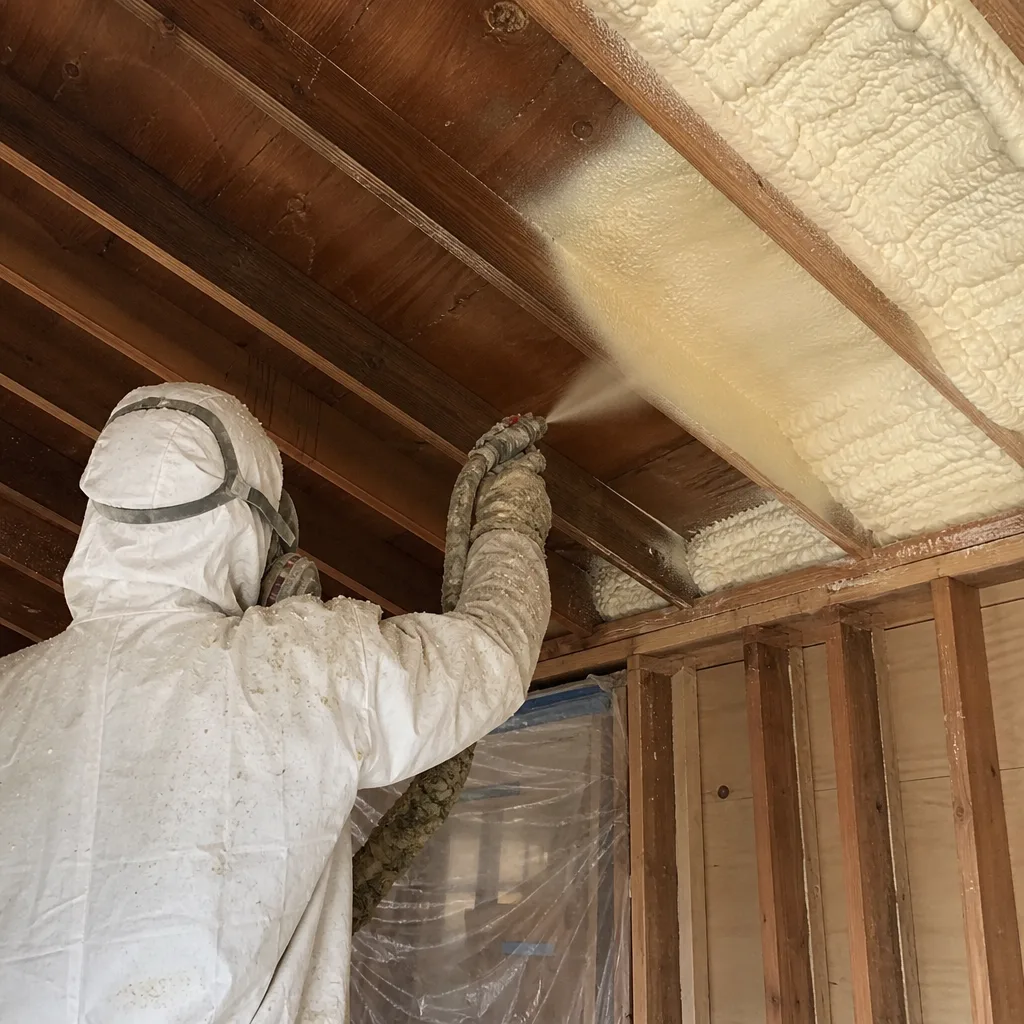
Garage Ceilings and Bonus Rooms
Attached garages and converted bonus spaces over garages are common on larger Lakeview lots. An uninsulated garage ceiling lets 150°F attic air radiate straight down into the car bay, which then bleeds into the house through the shared wall. Open cell foam on the garage ceiling is a cost-effective way to cut that heat transfer without rebuilding the garage. It’s a one-day job on most single and two-car garages.
Trusted Brands We Service in Lakeview
We install both Icynene and Demilec spray foam systems in Lakeview, which means we can spec open cell from Icynene for a clean vented attic one day, then closed cell from Demilec for a dusty unvented roofline the next. Both are warranted, name-brand systems installed to manufacturer spec. We also stock GreenFiber cellulose and Owens Corning batts for hybrid jobs where foam handles the air-sealing and blown-in or batts handle the bulk R-value. Lakeview homeowners don’t get an off-brand product with a fuzzy origin story from us. Eight brands, one honest recommendation, and a crew that can actually explain the difference.
Common Spray Foam Insulation Problems We See in Lakeview Homes
- Dust-packed vents starving foam jobs of airflow. The pass winds push fine grit into soffit and gable vents until airflow stops. Foam sprayed without clearing and rebalancing vents traps heat and moisture in the attic, even when the R-value looks right on paper.
- Compacted, grit-loaded original batts under new foam. A 1970s Lakeview ranch with R-19 batts that have been wind-compacted for 40 years is actually running around R-8. Foaming over that without air-sealing top plates and pulling the old material leaves the cooling-load target short.
- Uninsulated attached garages bleeding heat into living space. Larger-lot Lakeview homes often have attached garages that were never insulated. The shared wall becomes a radiant panel pushing 150°F air into the house every summer afternoon. Foam on the garage ceiling plus air-sealing the shared wall is the fix.
- Single-pane windows undermining a fresh foam job. Foam can seal the attic perfectly, but old single-pane windows on a Lakeview ranch will still pour heat in from the western exposure. We always walk the envelope and tell homeowners where the next biggest leak is, even if we’re not selling that fix today.
Pricing for Spray Foam Insulation in Lakeview, CA
A typical open cell attic sealing job in Lakeview runs $2,400 – $5,500. Closed cell on a roofline with rim joists runs $5,200 – $9,800. Garage ceiling foam runs $1,200 – $2,600. Rim joist sealing alone runs $900 – $2,100 depending on access. What moves the number is access, prep work, and whether we’re pulling out compacted old batts before we spray. A dusty 92567 attic with packed vents takes a few hours of prep that a clean attic doesn’t. We give flat, written estimates before any work starts, and we’ll tell you honestly if a hybrid approach using GreenFiber blown-in plus targeted foam gets you more R-value for the dollar. Call (877) 265-0627 and we’ll walk the property and price it exactly.
We Also Serve Cities Near Lakeview
Gallant Insulation Co runs crews out to Lakeview and the surrounding pass-country communities every week. In addition to Lakeview itself, we handle spray foam and insulation work in Nuevo, Romoland, Good Hope, and Perris. The same local conditions apply across this corridor: hot summers, wind-driven dust, older ranch housing stock, and attics that lose R-value early. If you’re on the edge of 92567 or just outside it, call and ask. Same crew, same pricing discipline, same material-agnostic advice.
Serving Lakeview, CA — Our Local Coverage Area
We’re based in the Lakeview area and know this community well. Use the map below to see our service coverage — if you’re nearby, we can almost certainly help.
FAQs About Spray Foam Insulation in Lakeview
Spray foam seals the attic envelope at the roofline or floor, so the pass-country winds that push dust and embers through vents and gaps can’t get in. Blown-in cellulose from GreenFiber is a solid product for the right attic, but on a windy Lakeview ranch with dust-packed vents, loose-fill simply acts as another filter. The wind keeps loading dust into the material until it compacts and loses R-value. Foam, especially closed cell, blocks that air path at the source. Call (877) 265-0627 and we’ll tell you which approach fits your attic.
Closed cell is the better default for a Lakeview ranch with an unvented attic, ember-intrusion concerns, or a roofline that sees full western sun. It’s an air barrier, a vapor barrier, and it adds structural strength to 1960s and 1970s framing. Open cell makes sense for vented attics that are already clean and dry, or for interior walls where you want sound dampening and air-sealing at lower cost. We install both Icynene and Demilec systems, so we’ll spec the one that actually fits your attic, not the one we’re incentivized to sell.
No, and this is exactly the failure we see on Lakeview homes where a previous contractor cut corners. Foam sprayed directly over compacted, grit-loaded batts leaves the old thermal dead zone in place and can trap dust against the deck. The right sequence is removing the failed material, air-sealing top plates and penetrations, then applying foam to the roofline or attic floor. It’s more prep work, but it’s the difference between an R-value that exists on paper and one that actually holds up through a 110°F Lakeview summer.
Lakeview’s triple-digit summers mean cooling load, not heating load, drives the insulation spec. An attic under composition shingles can hit 150°F and radiate that heat downward all afternoon. We typically recommend targeting R-38 to R-49 at the attic level, with closed cell foam at 3 – 4 inches on the roofline for unvented setups, or a hybrid of foam air-sealing plus blown-in to reach the target in vented attics. The heat is also why we emphasize garage ceiling insulation on larger lots, since an uninsulated attached garage becomes a heat reservoir that fights the AC every evening.
Yes, and it’s one of the most common jobs we do for Lakeview’s acreage and large-lot properties. An attached garage with no ceiling insulation is a giant radiant panel in the summer. We can foam the garage ceiling, air-seal the shared wall with the house, and even address oversized shop doors by sealing the perimeter and adding a foam panel where the framing allows. It’s a one-day job on most single-bay garages, and the difference in interior temperature is immediate. Written estimates are free, so call (877) 265-0627 and we’ll take a look.
Written by Nolan Pressler, Owner at Gallant Insulation Co, serving Lakeview and the pass-country corridor with spray foam, attic, and blown-in insulation.