


Fast, Reliable Spray Foam Insulation Across Quail Valley
Spray foam insulation in Quail Valley has to do something most coastal insulation never faces: hold up through daily temperature swings that climb past 100°F by afternoon and drop near freezing by midnight. Our crews work the 92587 ridge homes every week, and we know exactly what those thermal cycles do to a roof deck. If your vaulted ceilings bake upstairs rooms or your attic feels like an oven by noon, call Gallant Insulation Co at (877) 265-0627. We’ll send a tech who knows Quail Valley’s sloped lots and open-beam construction, not someone learning your neighborhood on a map.
Why Gallant Insulation Co Is Quail Valley’s Preferred Spray Foam Insulation Company
Quail Valley homeowners don’t get a generic pitch from us. We carry both Icynene and Demilec spray foam systems, which means the open-cell or closed-cell recommendation comes from your roofline and your temperature swing, not from whatever single system happens to be on our truck. That matters out here. A golf-course ranch backing the 92587 ridges has a different roof assembly than a flat-lot home near Canyon Lake, and the foam choice should reflect that. Nolan Pressler built our crew around material-agnostic recommendations: eight brands on the roster, three installation methods, and one honest answer for your specific house.
Response time to Quail Valley is typically same-day for estimates and within 48 hours for scheduling. We’re based in Murrieta, so we’re not routing a crew from two counties over. The techs who show up have sealed vaulted bays and open-beam ceilings on dozens of Quail Valley sloped-lot homes. They know where the slope-side batts slump, where the wind-driven heat cycling hits hardest, and where a sealed air barrier matters more than an extra inch of foam.
Open Cell Spray Foam in Quail Valley
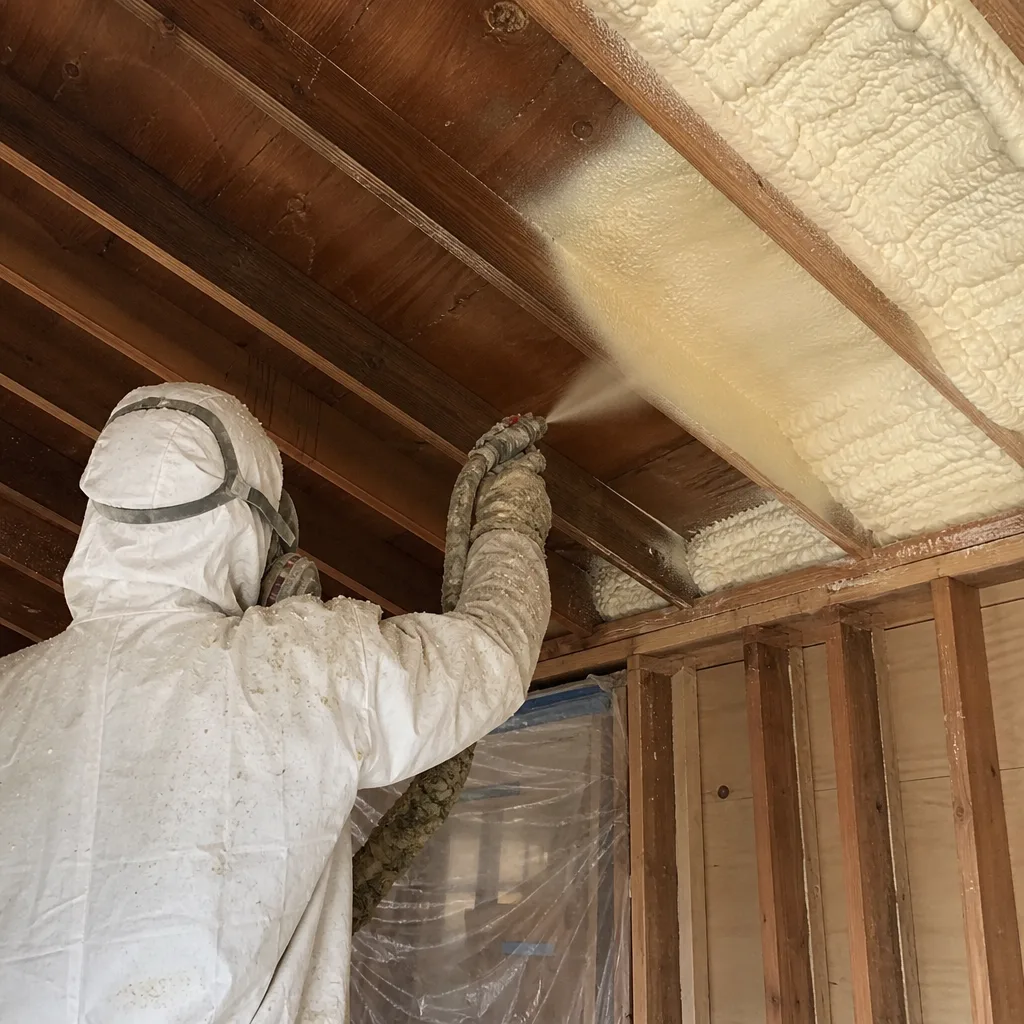
Open Cell Spray Foam in Quail Valley is the right call for most vaulted and open-beam ceilings where attic access is tight and the real enemy is air movement, not just heat. Open-cell expands aggressively into irregular bays, fills the odd angles of a sloped-lot roof deck, and lets moisture pass through, which matters when winter nights dip near freezing and condensation forms at the sheathing. For a typical Quail Valley ranch with cathedral ceilings, open-cell spray foam runs $2.10 to $3.40 per board foot installed, depending on bay depth and access.
Where Open Cell Fits Best
Open-cell works hardest in ceilings that have no attic cavity at all. On Quail Valley homes with open-beam or vaulted ceilings, the foam goes directly against the roof deck inside the rafter bays. It fills the full depth and seals the air boundary. In a home that swings from triple-digit afternoons to freezing nights, that air seal is what stops the thermal pumping from pulling conditioned air through every seam.
Open Cell vs. Closed Cell in Sloped-Lot Homes
Open-cell is softer and more forgiving than closed-cell, which matters when a roof deck flexes through a 70-degree daily range. Closed-cell is denser and adds structural rigidity, but open-cell moves with the framing. On a Quail Valley ranch built on a slope where the roof deck racks with every heat cycle, open-cell behind a rigid-board air barrier handles the movement without cracking or de-bonding at the seams.
Spray Foam Insulation Contractors in Quail Valley
Spray Foam Insulation Contractors in Quail Valley are not all equal. The difference is whether the crew knows what a 100°F-day-to-freezing-night thermal pump does to roof sheathing over a sloped lot. We do. Gallant Insulation Co installs both open-cell and closed-cell systems using Icynene and Demilec, and we’re one of the few contractors in the 92587 area who will tell you when spray foam is not the right fix. A typical spray foam job in Quail Valley runs $2,800 to $7,400 depending on square footage, bay depth, and whether we’re doing a rim joist job or a full roofline.
What a Quail Valley Spray Foam Job Involves
We start by mapping the roof assembly. On open-beam or vaulted ceilings, the bays are inspected from inside. On limited-attic sloped-lot homes, we test the existing insulation depth and look for the telltale slope-side slumping that wind-driven heat cycling causes. Then we seal, foam, and verify depth with a probe before the foam cures. No guessing, no shortcut passes.
When You Should Call a Contractor Instead of Waiting
If upstairs rooms cook by early afternoon even with the AC running, or if you can feel heat radiating from the ceiling at 4 p.m., the roof assembly is losing the fight. On ridge homes along the 92587 corridors, that heat buildup also dries out framing and accelerates shingle wear from the underside. Spray foam addresses the air movement and the radiant load in one application. Waiting another summer only makes the batts slump further down the slope.
Trusted Brands We Service in Quail Valley
Every Quail Valley job uses material from a named, warranted manufacturer. No unverifiable off-brand product goes into a Quail Valley roof. For spray foam, we install Icynene and Demilec: two competing systems, each with a documented track record for open-cell and closed-cell applications. When a homeowner needs mineral wool for a fire-rated assembly or a sound-dampening wall, we pull Rockwool from our Murrieta stock. When blown-in is the right call for a flat-attic section, we use GreenFiber cellulose. If the roofline calls for fiberglass batts in a specific bay, Owens Corning is on the shelf. The brand follows the job requirement, not the other way around.
Common Spray Foam Insulation Problems We See in Quail Valley Homes
- Slumped builder-grade batts on slope-side roof decks. Wind-driven heat cycling shakes blown-in and batts loose, leaving the upper bays bare. Spray foam bridges those bays and stays put because it adheres to the deck itself.
- Cracked or de-bonded foam at vaulted bay seams. When foam is applied without a rigid-board or sealed air barrier, the daily 70-degree swing thermally pumps the sheathing and cracks the foam at the joints. We detail those seams before foaming.
- Superheated attics on golf-course and open-hillside homes. Homes backing the course or open ridges along the 92587 corridors get direct afternoon sun with no tree canopy. Attic temps routinely exceed 140°F, which cooks stored items and forces the AC to work double shifts.
- Limited-attic ranches with cathedral ceilings. Many 1980s and 1990s Quail Valley builds left less than 12 inches of attic space over vaulted rooms. Standard blown-in can’t reach those bays. Spray foam applied directly to the deck is the only way to insulate the full rafter depth.
Pricing for Spray Foam Insulation in Quail Valley, CA
Spray foam pricing in Quail Valley breaks down by application. Open-cell roofline foam runs $2.10 to $3.40 per board foot. Closed-cell runs $2.80 to $4.60 per board foot. A rim joist job on a typical Quail Valley crawlspace runs $1,100 to $2,400. A full vaulted-ceiling retrofit on a 1,800-square-foot ranch runs $4,200 to $7,400. Garage ceiling spray foam runs $1,600 to $3,100 depending on whether we’re foaming the deck or the walls too. What moves the number: bay depth, access, whether we need to remove old slumping batts first, and whether a rigid-board air barrier is required at the vaulted seams. Call (877) 265-0627 for an exact quote on your Quail Valley home. Estimates are free.
We Also Serve Cities Near Quail Valley
Gallant Insulation Co works across the Inland Empire’s sloped-lot communities. In addition to Quail Valley, our crews cover Sun City, Canyon Lake, Meadowbrook, and Romoland. Each area has its own roofline quirks, and our Spray Foam Insulation team adjusts the detail work to match.
Serving Quail Valley, CA — Our Local Coverage Area
We’re based in the Quail Valley area and know this community well. Use the map below to see our service coverage — if you’re nearby, we can almost certainly help.
FAQs About Spray Foam Insulation in Quail Valley
Spray foam makes more sense because it adheres directly to the roof deck instead of sitting in a batten pocket that gravity and heat cycling empty out. On Quail Valley vaulted ceilings, fiberglass batts slump toward the slope-side of the roof within a few summers, leaving the upper bays bare. Foam fills the full rafter depth and stays there. It also air-seals the bay, which batts can’t do. For an exact recommendation on your ceiling, call (877) 265-0627 and we’ll walk the roofline with you.
Open-cell is usually the right call for a Quail Valley ridge home with vaulted ceilings, because it moves with the roof deck through the daily thermal pump without cracking. Closed-cell adds vapor control and structural rigidity, which matters more on a flat-roof section or a garage ceiling. The answer comes down to your specific roofline and whether condensation is a risk at the sheathing. Call (877) 265-0627 and we’ll tell you which one your roof actually needs.
Spray foam flexes with the deck if it’s applied correctly. The problem comes when installers skip the seam detailing or apply foam over a dirty or uneven surface. On a Quail Valley roof that swings 70 degrees daily, the sheathing expands and contracts constantly. Foam that’s properly bonded and detailed at the vaulted bay seams handles that cycle. Foam that’s slapped on without a sealed air barrier cracks and de-bonds at the joints. That’s why we detail every seam before foaming.
Yes. Golf-course homes along the 92587 ridges get direct afternoon sun with no tree canopy, so their attic spaces superheat faster than shaded lots. The open hillside exposure also drives wind through the eave vents, which accelerates heat cycling on the slope-side of the roof. We routinely find blown-in insulation settled unevenly and batts pulled loose on the slope-side of these homes. Spray foam applied directly to the deck eliminates that failure mode. Call (877) 265-0627 to schedule an inspection.
Yes, and that’s actually one of the jobs we do most in Quail Valley. On limited-attic sloped-lot ranches, there’s no room to crawl into the lower bays. We apply open-cell foam directly against the roof deck from inside the vaulted ceiling, which fills the full rafter depth and air-seals the bay. A rigid-board air barrier at the vaulted seams stops the thermal pumping from cracking the foam at the joints. This is the classic Quail Valley cathedral-ceiling fix. Call (877) 265-0627 and we’ll map your roofline before recommending anything.
Ready to Fix the Thermal Swing in Your Quail Valley Home?
If your upstairs rooms bake by early afternoon, if your attic hits 140°F by noon, or if you can feel heat radiating through the ceiling at 4 p.m., the roofline is losing. Gallant Insulation Co carries Icynene and Demilec, installs open-cell and closed-cell, and details every vaulted bay seam before foaming. Nolan Pressler’s crew works Quail Valley’s ridge homes every week and knows what this climate does to insulation. Call (877) 265-0627 for a free estimate. We’ll send a tech who knows your roofline, not a salesperson reading a brochure.
Written by Nolan Pressler, Owner at Gallant Insulation Co, serving Quail Valley and the surrounding Inland Empire communities.