


Fast, Reliable Spray Foam Insulation Across Canyon Lake
Spray foam insulation in Canyon Lake typically costs $2.80 to $7.25 per board foot installed, depending on whether you need open-cell or closed-cell foam. Most rim joist jobs in the 92532 zip code land between $1,200 and $2,800, while a full crawl space encapsulation runs $4,500 to $9,500. We work in Canyon Lake every week, and we know exactly what these lake-adjacent homes throw at their insulation. Call Gallant Insulation Co at (877) 265-0627 for a free estimate, and we’ll give you a straight answer on what your house actually needs.
Why Gallant Insulation Co Is Canyon Lake’s Preferred Spray Foam Insulation Company
Canyon Lake homeowners call us because we show up with more than a spray rig and a sales pitch. Nolan Pressler runs every Canyon Lake job with the same question driving the recommendation: what does this specific house, on this specific lot, need to handle inland-valley heat and lake humidity together? We carry both Icynene and Demilec spray foam systems, which matters more than most people realize. Open-cell foam handles interior walls and sound control. Closed-cell foam handles rim joists, crawl space walls, and anything touching the lake-air environment. A single-system shop can’t offer that choice. We can.
Our crews know the gated entry protocol, the HOA rhythm, and the older 1970s-to-2000s housing stock that dominates Canyon Lake. That local familiarity cuts hours off the typical job, because we’re not figuring out where the rim joist sits or what the attic access looks like on a first visit. We’ve done it on Canyon Lake Drive South, on hillside streets off Goetz Road, and in lakefront communities where afternoon humidity complicates every crawl space decision. The reviews from Canyon Lake customers keep mentioning the same thing: we removed what was failing before we sprayed anything new.
Rim Joist Spray Foam in Canyon Lake
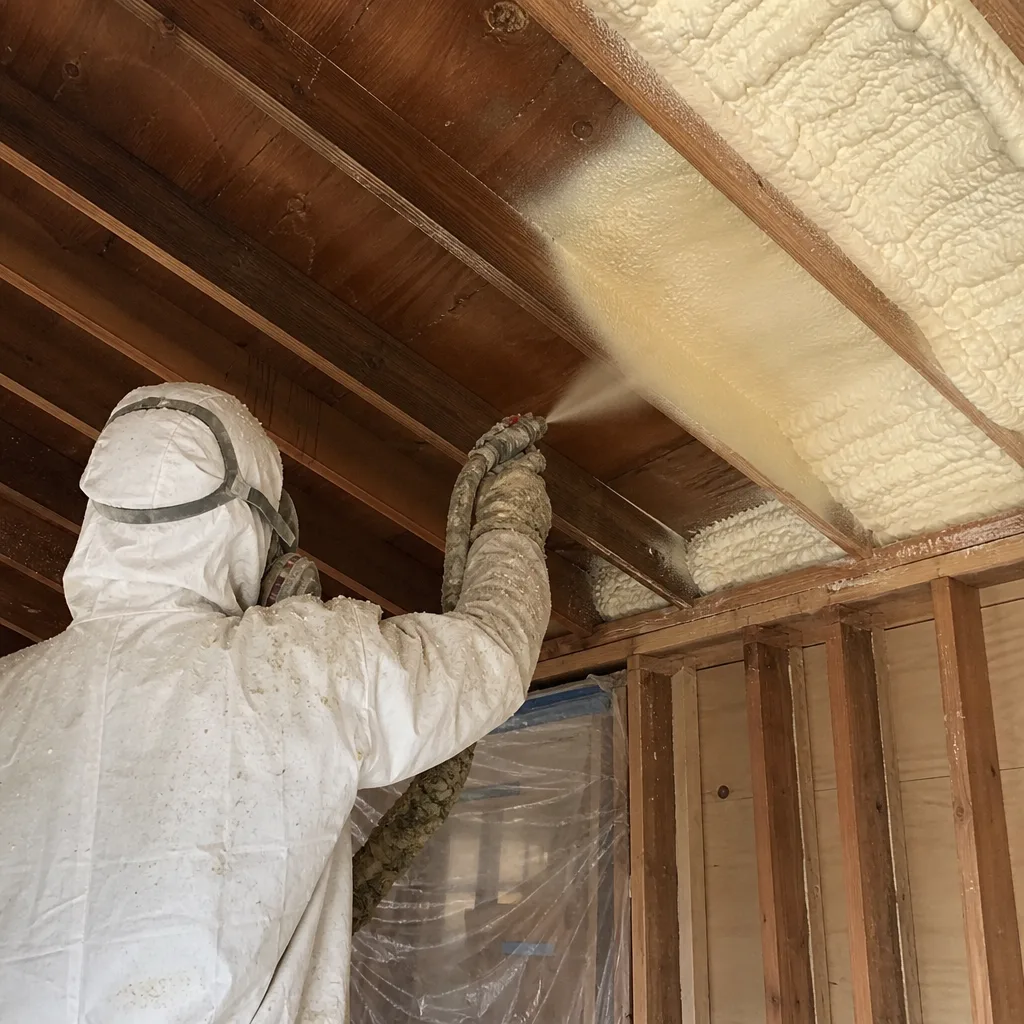
Rim joist spray foam is the first thing we check in Canyon Lake homes because the band joist is where hot inland air pours into the house, but it’s also where aged, dusty wood from 1980s construction causes adhesion failures. Rim joist spray foam in Canyon Lake runs $1,200 to $2,800 for a typical single-story home. The job involves cleaning the wood substrate, priming where needed, and applying closed-cell foam to the band joist and sill plate. In older Canyon Lake homes, skipping the cleaning step means the foam pulls away within a season, and you’ve paid for nothing.
Why Canyon Lake Rim Joists Need Closed-Cell, Not Open-Cell
Closed-cell foam gives you a vapor barrier and R-6.5 per inch, which is what a band joist exposed to lake humidity needs. Open-cell foam lets moisture move through, and that’s the wrong call when afternoon humidity off the lake sits against the rim joist for hours. Most Canyon Lake homes we assess need closed-cell at the rim joist, even if we use open-cell elsewhere.
Substrate Prep on Older Canyon Lake Homes
Dust, old spider webs, and decades of stucco dust settle onto the rim joist in 1970s and 1980s builds. In Canyon Lake, that surface gets even grittier because west-facing walls bake all summer and shed fine particles. We clean and vacuum the band joist before any foam goes on. On homes where original fiberglass batts were tucked into the joist bays, we remove those first and check for moisture staining at the sill plate before we spray.
Crawl Space Spray Foam Insulation in Canyon Lake
Crawl space spray foam insulation in Canyon Lake typically costs $4,500 to $9,500 for encapsulation of a standard 1,200 to 2,000 square foot footprint. The first thing a Canyon Lake homeowner needs to understand is that spraying foam over a crawl space with original vents left open is a wasted job. Vented crawl spaces in hillside homes along the east side of the lake pull in hot inland air all summer, which bypasses the foam and drives humidity up against the floor assembly. We see this on nearly every hillside property off Vacation Drive and along the slopes above the lake’s east shore.
Closing Vents Before Foam in Canyon Lake Crawl Spaces
Original crawl space vents from 1970s and 1980s builds were designed for a different climate era, when cooling loads weren’t what inland Riverside County demands today. Before we spray the band joist or crawl space walls, we seal the vents and address any groundwater seepage at the foundation. On Canyon Lake hillside lots, water sheds toward the downhill foundation wall, so we check for efflorescence and damp soil before recommending foam placement.
Band Joist Failures in Hillside Canyon Lake Homes
The band joist is where we find the most expensive mistakes in Canyon Lake crawl spaces. In hillside homes where original vents stay open, hot air moves straight through the vent, across the crawl space, and hits the back side of the band joist. The foam can’t do its job if that air path stays open. We seal the vent and verify the foam is applied continuously from the sill plate to the subfloor above before we call a crawl space job complete.
Trusted Brands We Service in Canyon Lake
Gallant Insulation Co carries both Icynene and Demilec spray foam systems, which means the recommendation for your Canyon Lake home is driven by the job, not by what’s in the truck. Icynene’s closed-cell formulation is our go-to for rim joists and crawl spaces in lake-humidity zones. Demilec covers the open-cell side when we’re insulating interior walls or a bonus room above the garage. We also stock Rockwool for Canyon Lake customers who want a non-combustible option in an attached garage or a mechanical room. Fast turnaround matters here, too: because we’re based in nearby Murrieta, we can get material to Canyon Lake the same day most projects start.
Common Spray Foam Insulation Problems We See in Canyon Lake Homes
- Fallen fiberglass batts on west-facing roof slopes. The sun pounds the west roof slope all afternoon, and in lakefront homes along Canyon Lake Drive South, the added humidity off the water accelerates batt collapse. By the time we arrive, the batts are often sagging against the drywall.
- Rusted radiant-barrier staples. Older Canyon Lake homes had radiant barriers stapled to the rafters. After a few decades of 150-degree attic heat and humid lake air, those staples rust through and the barrier droops. We remove the failed barrier before quoting any spray foam work.
- Closed-cell foam applied over existing fiberglass. Some contractors spray foam directly over old batts to save time. In Canyon Lake, that traps lake-humidity moisture against the roof deck and accelerates rot. It’s a shortcut we refuse to take.
- Rim joist foam pulling away from aged wood. Dusty, decades-old band joists in 1970s through 2000s homes need cleaning and priming before foam. Skip it and the foam delaminates within a season or two, especially on the west and south exposures.
Pricing for Spray Foam Insulation in Canyon Lake, CA
Rim joist spray foam in Canyon Lake runs $1,200 to $2,800 for a standard single-story home. Crawl space encapsulation in the 92532 zip code runs $4,500 to $9,500 depending on square footage and whether we’re also sealing vents or addressing moisture at the foundation. Attic spray foam, when it’s the right call, runs $3.50 to $7.25 per board foot for closed-cell and $1.80 to $3.50 for open-cell. What moves the number: the cleanup cost for failed legacy materials, condition of the substrate, and whether the crawl space needs vent sealing before foam goes on. Call (877) 265-0627 for a free estimate, and we’ll walk the house with you before we quote a number.
One more thing about Canyon Lake pricing: this is a gated city where original fiberglass batts in west-facing roof slopes sag from lake humidity and 150 to 170 degree attic heat. So spray foam jobs here often start with removing fallen batts and rusted radiant-barrier staples before any rim joist or crawl space application. That prep time is part of an honest quote, and it’s why a Canyon Lake job sometimes costs more than the same square footage in Lake Elsinore or Murrieta.
Our Spray Foam Insulation team carries both Icynene and Demilec systems, so the foam spec matches what your Canyon Lake house needs, not what a single-brand shop is trying to move that month.
On a 1980s lakefront home off Canyon Lake Drive South, our crew found the west-facing roof slope’s fiberglass batts collapsed and the radiant barrier staples rusted through. We removed the failed batts, vacuumed the deck, and sprayed Icynene closed-cell foam along the rim joist and crawl space walls to seal the assembly, then verified attic venting was clear before recommending a radiant-barrier retrofit. That’s the order of operations here: remove what failed, then apply what works.
We Also Serve Cities Near Canyon Lake
Gallant Insulation Co runs spray foam and insulation crews from Murrieta into Canyon Lake weekly, and we cover Meadowbrook, Sedco Hills, Lakeland Village, and Quail Valley on the same schedule. If you’re in Canyon Lake or any neighboring community, the same crew and the same eight-brand material roster serve your job. Call (877) 265-0627 and we’ll get you on the schedule.
Serving Canyon Lake, CA — Our Local Coverage Area
We’re based in the Canyon Lake area and know this community well. Use the map below to see our service coverage — if you’re nearby, we can almost certainly help.
FAQs About Spray Foam Insulation in Canyon Lake
No. Spray foam applied over old fiberglass batts traps lake-humidity moisture against the roof deck and creates conditions for deck rot. In Canyon Lake, where afternoon humidity off the lake is a real factor, the failed batts and rusted radiant-barrier staples need to come out first. We remove the legacy materials, vacuum the deck, check venting, and only then apply foam where it belongs. Call (877) 265-0627 for an assessment.
Canyon Lake homes sit right against the water, so the band joist is exposed to afternoon humidity that Lake Elsinore homes further from the shore don’t get. That moisture, combined with dusty aging wood in 1970s to 2000s builds, makes substrate prep and closed-cell foam selection more critical. Skip either, and the foam delaminates or lets moisture through. Canyon Lake rim joists need closed-cell, and they need the wood cleaned first.
Yes, the vents should be closed before foam goes on the band joist or crawl space walls. Original vents from the 1980s let hot inland-valley air pour into the crawl space all summer, which bypasses the foam and pushes humidity against the floor assembly. We seal the vents, verify moisture conditions at the foundation, and then apply foam to a closed assembly.
If you can see sagging, drooping, or gaps in the radiant barrier, the staples are likely rusted through and the barrier isn’t doing its job. In Canyon Lake attics that hit 150 to 170 degrees and carry lake humidity for hours, staple failure is common after 15 or 20 years. We inspect the attic as part of any spray foam quote and include barrier removal in the scope if the staples have failed.
You don’t need a specific brand, but you do need closed-cell foam with a vapor barrier rating high enough for humid lake-air conditions. We carry both Icynene and Demilec, and for Canyon Lake crawl spaces we typically spec Icynene’s closed-cell formulation because it delivers the moisture resistance and R-value per inch these spaces demand. The brand matters less than the cell structure and the install quality. Call (877) 265-0627 for a free crawl space assessment.
Written by Nolan Pressler, Owner at Gallant Insulation Co, serving Canyon Lake since our first lakefront retrofit.