
Emergency Attic Insulation Near Me: What Murrieta Homeowners Should Do First
If you’re searching “emergency attic insulation near me” in Murrieta, the first thing to do is slow down and triage the actual problem. A sudden 40% spike in your cooling bill during a heat wave is rarely an insulation failure. It’s more likely an HVAC refrigerant leak or a duct breach, and calling an insulation contractor first will delay the real fix by days. Before you spend money on emergency service, spend 10 minutes confirming the insulation is actually the problem. If you’d rather not sort through it yourself, call us at (877) 265-0627 and we’ll help you figure out what’s actually going on.
We’ve spent years working in attics across Murrieta, from the older homes near Historic Downtown to the newer builds off Clinton Keith Road, and the pattern is consistent: what feels like an insulation emergency is often a ventilation problem, a duct problem, or a roof problem wearing an insulation costume. Here’s how to tell the difference, what to do in the first 90 minutes, and when a same-day call actually makes sense.
Real vs. Perceived Insulation Emergencies: The 10-Minute Decision Tree
Most “insulation emergencies” fall into one of three buckets. Only one of them requires immediate insulation work. Here’s the decision tree we walk Murrieta homeowners through when they call us in a panic.
Bucket 1: Storm damage with visible breach. Santa Ana winds tore off a section of roof, or a tree limb punched through the decking, and you can see daylight or feel rain coming into the attic. This is a true emergency, but the emergency is the roof penetration, not the insulation. The insulation becomes urgent only after the opening is sealed. Wet or displaced insulation needs removal and replacement, but sealing first, insulating second, always.
Bucket 2: Performance degradation. Your energy bills have crept up over months, or certain rooms feel five to eight degrees warmer than others. This is a scheduled job, not an emergency. Attic insulation in Murrieta degrades slowly: blown-in cellulose settles, fiberglass batts get compressed by storage boxes or foot traffic, and the R-value drops a little each year. You need a proper assessment, not a midnight service call.
Bucket 3: HVAC-adjacent failures that mimic insulation loss. This is the sneaky one. Your AC runs constantly, the upstairs won’t cool below 78, and the house feels muggy. The insulation looks old, so you blame the insulation. But in our experience, what’s actually failing is a refrigerant charge, a clogged coil, or a duct that’s separated in the attic and is dumping conditioned air into unconditioned space. Insulation doesn’t fail suddenly. HVAC systems do.
If you’re in bucket 3, new insulation won’t fix the problem. You’ll spend $4,000 to $8,000 on R-38 blown-in and still have a hot upstairs. Check the HVAC first, then evaluate insulation.
The First 90 Minutes After You Suspect Attic Damage
Let’s say you’ve confirmed something actually happened: you heard a limb hit the roof, or you spotted a water stain on the ceiling, or you smelled smoke strongly during the last wildfire event. Here’s the sequence that protects your home and your insurance claim.
Step 1: Document everything before you touch anything. Take photos of the ceiling stain, the attic floor, the insulation condition, and any visible roof damage from the outside. Insurance adjusters in Riverside County move faster when you hand them timestamped photos from the first hour. If you move or remove insulation before documenting, you’re making the adjuster’s job harder and your claim weaker.
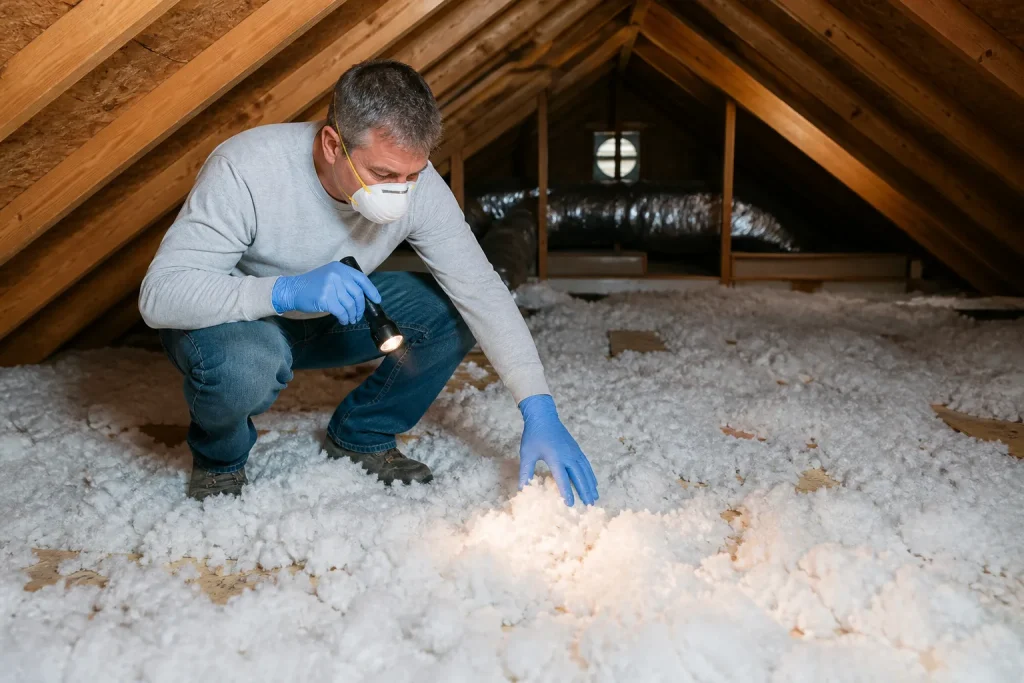
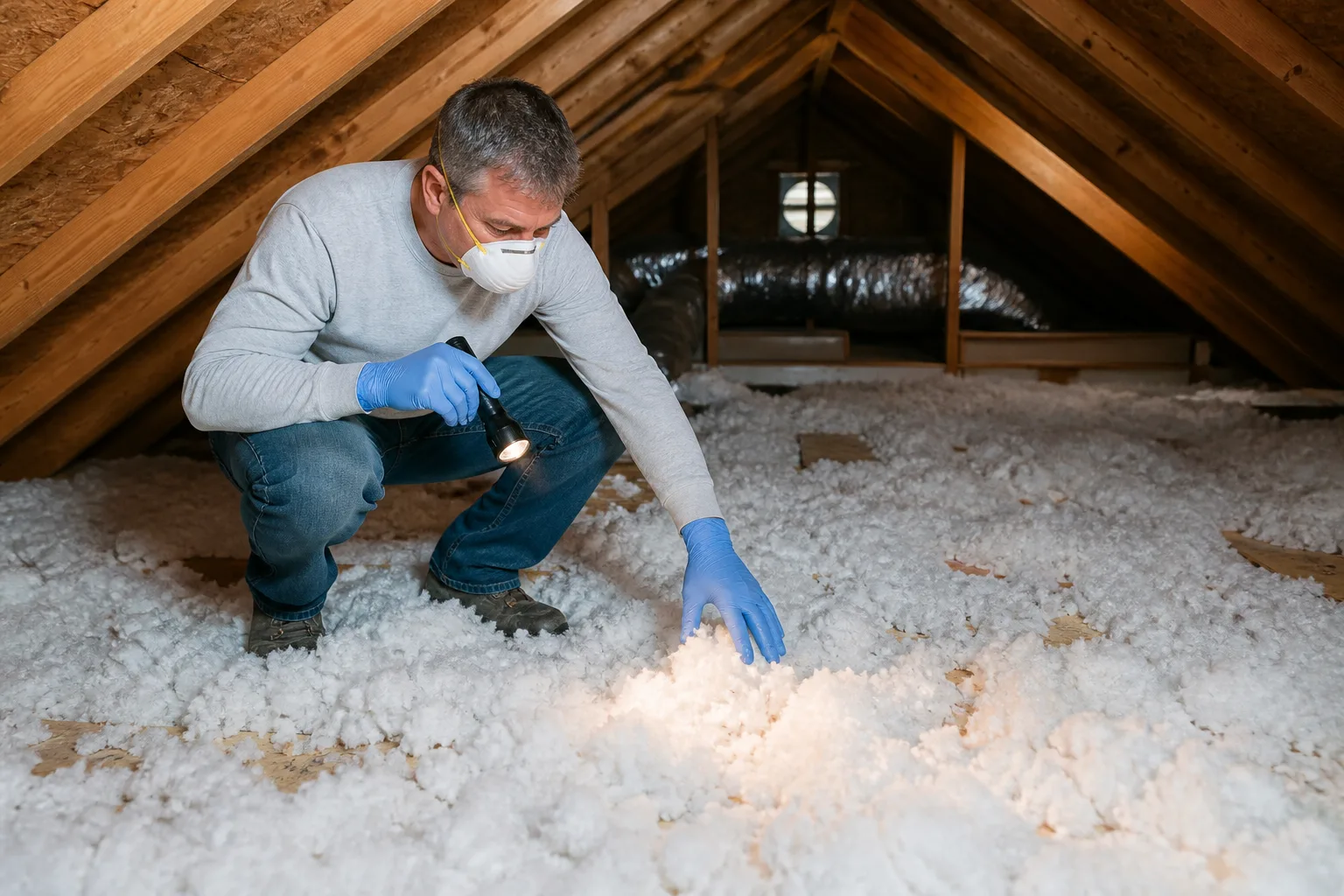
Step 2: Check the attic from the hatch, not by walking around. If you suspect a roof breach, do not walk across the attic floor. Wet blown-in insulation hides soft spots in the drywall below, and you can put a foot through the ceiling. Shine a flashlight from the hatch and look for wet insulation, displaced batts, or daylight coming through the decking. If you see any of those, call a roofer first.
Step 3: Temporary seal only what you can reach safely. If there’s a small gap around a vent or a minor opening you can reach from the hatch, a tarp or plastic sheeting stapled over it from inside is fine for 24 to 48 hours. But if blown-in product is involved, don’t rake it around or pile it up. Disturbing settled cellulose or fiberglass changes the density and voids the manufacturer’s performance assumptions. Leave it in place and let a contractor assess it.
Step 4: Call your insurance company before any contractor starts work. Murrieta homeowners with wind, hail, or wildfire damage on their policy should start the claim before any repair begins. Some policies require the adjuster to see the damage in its original state. Get that call made within 24 hours.
Post-Storm Attic Inspections: Four Systems, Not One
When a Murrieta homeowner calls us after a Santa Ana event or a monsoon moisture push, they usually ask us to “check the insulation.” What they actually need is an assessment of four interconnected systems, because insulation damage rarely happens in isolation. Here’s what a proper post-storm inspection covers and why each one matters.
1. Roof deck integrity. Lifted shingles, cracked decking, or loose flashing all allow water and wind-driven debris into the attic. Insulation can’t do its job if the roof above it is compromised. We check for water staining on the decking and daylight penetration before we even think about insulation.
2. Vapor barrier condition. In Murrieta’s dry climate, vapor barriers work differently than they do in humid regions. But after moisture intrusion, a torn or sagging barrier traps humidity against the insulation and accelerates mold and R-value loss. If the barrier is compromised, the insulation above it needs attention too.
3. Duct connections. Attic ductwork takes a beating during high-wind events. A separated duct joint doesn’t just leak conditioned air; it pulls attic insulation dust and debris into your living space. We inspect duct connections as part of any post-storm attic assessment because an insulation contractor who ignores ducts is only seeing half the problem.
4. Attic ventilation path. Soffit vents clogged with wind-blown debris, ridge vents blocked, gable vents pushed askew: all of it changes the airflow that keeps your attic from baking in the Murrieta summer. Insulation and ventilation work together. If the ventilation path is blocked, the best insulation on the market will still leave you with a 130-degree attic.
What ‘Same-Day Service’ Actually Means for Insulation Work
You’ll see “emergency insulation” advertised all over the place, and we want to be honest about what that phrase can and can’t deliver. Here’s the unvarnished version.
A temporary patch can happen same day. If you have a localized issue, a small area of wet insulation to remove, or a specific gap to seal, a crew can be there that afternoon. We’ve done same-day emergency work in Murrieta when a storm opened a section of roof and the homeowner needed the insulation pulled before the tarp went up. That’s realistic.
A full reinstall cannot happen same day. Proper attic insulation removal and reinstallation is a multi-step process: remove the compromised material, inspect the decking and barriers, air-seal the bypasses, install the new product to manufacturer spec, and verify the ventilation path. That’s not a four-hour job. Any contractor who promises a complete same-day attic reinstall is cutting corners somewhere, usually on air sealing or depth.
What you should ask the contractor: What exactly will you do today, and what will you schedule for later? A legitimate emergency response is triage: stop the damage, protect the home, and schedule the permanent repair properly. If a contractor can’t answer that question clearly, get another quote.
When you call Gallant Insulation Co for an emergency assessment, here’s what we’ll tell you honestly: whether the problem is insulation at all, whether it’s urgent or can wait a week, and what the right material is for your specific attic. We carry Gallant Insulation Co home resources and product knowledge across eight manufacturer lines, including Knauf fiberglass and Rockwool mineral wool, so our recommendation is driven by what your attic actually needs, not what’s on the truck that day.
Murrieta-Specific Emergency Scenarios We See Most Often
Every market has its own flavor of insulation problems. In Murrieta, three scenarios dominate our emergency calls, and each has a different triage path.
Santa Ana wind events. October through January, the winds push 40 to 60 mph through the foothills and over the plateau. What we see most: wind-blown debris clogging soffit vents, displaced ridge vents, and pressure differentials that pull conditioned air out of the home faster than usual. The insulation itself is rarely damaged, but the ventilation system that supports it takes a beating. If your energy bill jumps after a Santa Ana event, check the vents before you replace the insulation.
Monsoon moisture intrusion. Late summer brings humidity spikes that Murrieta homes aren’t built for. Moisture that gets into the attic condenses on the underside of the decking at night and drips onto the insulation. Small amounts dry out; repeated exposure doesn’t. Wet fiberglass loses R-value permanently. Wet cellulose settles and compacts. If you’ve had a monsoon season with repeated moisture intrusion, get the insulation checked even if you don’t see a ceiling stain.
Post-wildfire smoke infiltration. After a wildfire event, smoke and fine particulate matter penetrate attics through bypasses: recessed light fixtures, plumbing penetrations, attic hatches, and the gap where the wall meets the ceiling. Smoke-infused insulation holds odor for months and can continue off-gassing into the living space. This is a situation where Attic Insulation in Murrieta replacement is often the right call, not just a cleaning. We’ve pulled smoke-saturated batts out of homes off Warm Springs Parkway where the homeowner had tried everything else first: air purifiers, duct cleaning, ozone treatments. The smell came back until the insulation came out.
If you’re dealing with any of these Murrieta-specific scenarios and you’re not sure whether it’s an emergency, call us at (877) 265-0627. We’ll tell you straight whether it’s urgent or can wait a week.
What to Do While You Wait for Service
If you’ve confirmed an insulation problem but can’t get a crew out until tomorrow or next week, here’s what actually helps in the meantime.
- Keep the attic hatch closed and sealed. If the hatch is in the garage or a hallway and the seal is worn, a rolled towel under the door blocks 80% of the stack effect pull from the attic into the living space.
- Don’t run the whole-house fan. In Murrieta, whole-house fans are common in older homes. If your attic has compromised insulation or a ventilation problem, running the fan pulls hot, dusty attic air directly into the living space.
- Don’t pile boxes or storage on top of compromised insulation. Compression is permanent for both fiberglass and cellulose. Every inch of compression drops the effective R-value, and the material doesn’t bounce back.
- Close the blinds on south and west-facing windows. It’s a small thing, but it cuts solar gain enough to take the edge off while you wait. Every degree you keep out of the house is a degree the attic doesn’t have to absorb.
And one note from the “we pulled one out of a garage” file: we did a job last year over near Los Alamos Hills where the homeowner had been battling a hot upstairs bedroom for three summers. They’d added radiant barrier, they’d sealed the windows, they’d done everything short of new insulation. Turns out the original builders had installed R-19 batts in an attic that spec’d R-38 for this climate zone. The insulation wasn’t failing, it was simply never enough. The fix took one afternoon with Blown In Insulation in Murrieta to bring it up to spec, and the bedroom dropped five degrees within a week. Sometimes the emergency is real, the cause is just not what you assumed.
Related services in Murrieta: if your assessment points toward sealing and insulating the attic floor, see our Spray Foam Insulation in Murrieta page for the air-sealing options we install, including Icynene open-cell and Demilec closed-cell systems.
The Bottom Line
The search “emergency attic insulation near me” comes from a real problem, but the problem is not always what the search implies. Before you pay for emergency service, confirm the insulation is actually the issue. Check whether it’s storm damage, gradual degradation, or an HVAC failure that’s mimicking insulation loss. Document everything if you’re filing a claim. And when you do need insulation work in Murrieta, whether it’s today or next month, understand that a proper job is a process: assessment, air sealing, material selection, and installation to manufacturer spec. Gallant Insulation Co carries eight named brands including Knauf, Rockwool, CertainTeed, and Icynene, and we install three distinct methods, attic batts, spray foam, and blown-in, because the right answer depends on your specific attic, not on what we happen to stock. If you’re in Murrieta and need help, Gallant Insulation Co offers free estimates. Call (877) 265-0627 and we’ll help you figure out what’s actually going on up there.
Frequently Asked Questions
An insulation emergency is defined by active water intrusion, visible smoke saturation, or displaced material exposing your ceiling to outdoor temperatures. A gradual rise in your Murrieta energy bill over several months is a scheduled job, not an emergency. If you see wet insulation or daylight through the decking, call a roofer first, then an insulation contractor.
A temporary patch or localized removal can often be done same day, but a full attic reinstall takes longer if it’s done properly. The process includes removal, air sealing, inspection, and installation to manufacturer depth. Be wary of any contractor who promises a complete same-day reinstall; it usually means they’re skipping air sealing or depth verification. Call (877) 265-0627 to get an honest timeline for your specific attic.
It depends on the cause. Storm damage, wind-driven water intrusion, and wildfire smoke infiltration are typically covered if you have the right policy. Gradual degradation from age or compression is not. Document everything with photos before any work begins, and start the claim within 24 hours of the damage. Your adjuster will want to see the original condition.
For localized damage, repair is usually cheaper. For widespread moisture contamination, heavy smoke saturation, or insulation that never met spec in the first place, full replacement is the better long-term investment. In Murrieta attics, the right answer depends on the damage pattern, the existing material type, and your energy goals. Call (877) 265-0627 for an exact recommendation, estimates are free.
Written by the team at Gallant Insulation Co, serving Murrieta since 2014.
Need Insulation Help?
Call Gallant Insulation Co — licensed & insured, here with fast after-hours help in Murrieta.
(877) 265-0627