Rockwool Attic Insulation in Murrieta: A Homeowner’s Guide
Rockwool attic insulation in Murrieta typically costs $1.80 to $3.10 per square foot installed, which runs higher than blown fiberglass but delivers fire resistance, sound dampening, and moisture control that most other materials can’t match. If you’re weighing Rockwool against other options, the short answer is this: in Murrieta’s fire-prone, high-temperature-swing climate, the premium usually pays for itself in safety and long-term performance. If you’d rather skip the research and get a straight recommendation for your attic, call (877) 265-0627 for a free estimate.
Rockwool won’t melt until 2,150°F. The ignition point of most structural framing sits around 572°F. That means in a wildland-urban interface fire event, your insulation outlasts your rafters. That’s not a marketing claim; it’s a material science fact that changes the calculus for Murrieta homeowners.
Why Murrieta’s Fire Risk Changes What Attic Insulation Should Do
Murrieta sits squarely in Riverside County’s wildland-urban interface zone, often called the WUI. That designation isn’t bureaucratic jargon. It means the California Department of Forestry and Fire Protection has mapped our neighborhoods as areas where homes meet undeveloped land, and where ember-driven fire spread becomes the primary threat during Santa Ana wind events.
Here’s what matters for your attic: embers don’t need direct flame contact to ignite a house. They land in vents, gather against eaves, and settle into crevices where exposed insulation meets framing. Blown fiberglass melts around 1,050°F. Cellulose, even with fire retardants, chars and smolders. Rockwool stone wool is non-combustible, full stop. It carries a Class A fire rating and does not contribute to flame spread or smoke development in the way organic or glass-based insulations can.
We’ve installed Rockwool in homes throughout Murrieta’s Copper Canyon and Bear Creek areas, where lots back directly onto chaparral. In those neighborhoods, an attic insulation choice doubles as a passive fire-hardening measure. That’s not something a spec sheet tells you clearly, but it’s the practical reality contractors working in WUI zones understand.
Rockwool’s Density and Thermal Mass Matter More Than Most Homeowners Realize
Murrieta’s diurnal temperature swing is aggressive. Summer days push past 95°F, then nights drop into the low 60s. That’s a 30-degree-plus swing, and your attic sees amplified versions of it. The space between your roof deck and ceiling can swing 50 degrees in a single 24-hour cycle during July and August.
Low-density blown fiberglass responds to these swings quickly. It heats up fast, releases heat fast, and lets your attic temperature cycle almost in real time with the sun. Rockwool batts and boards carry more thermal mass. Their density, typically 4 to 8 pounds per cubic foot for batt products versus roughly 0.5 to 1 pound for loose-fill fiberglass, means they absorb and release heat more slowly. The result: your attic temperature curve flattens. Peak temperatures stay lower, and the heat that does build up takes longer to push through your ceiling into living space.
This thermal lag effect won’t replace air sealing or ventilation, but it works alongside both. In a Murrieta summer, where afternoon attic temps routinely exceed 140°F, even a 10-degree reduction in peak attic temperature trims HVAC runtime in meaningful ways.
Where Rockwool Underperforms for Murrieta Attics (And When We Recommend Something Else)
Rockwool earns its premium in specific conditions. It does not earn it everywhere. Here’s where we tell Murrieta homeowners to look elsewhere, based on what the job actually requires.
- Low-pitch roofs with shallow rafter bays. Rockwool batts need depth to hit target R-values. A 2×6 rafter bay limits you to roughly R-19 with Rockwool unless you add rigid board, which drives cost up quickly. In shallow bays, closed-cell spray foam from Icynene or Demilec delivers more R-value per inch and air-seals in one step.
- Unconditioned attic floors with deep joist cavities. If your attic has 2×10 or 2×12 floor joists and you’re insulating the ceiling plane, blown fiberglass from CertainTeed or Knauf hits R-38 to R-49 at a fraction of Rockwool’s cost per R-value. Rockwool installed as attic floor batts costs roughly 2 to 2.5 times more per R-value than blown fiberglass.
- Irregular joist bays and older framing. Rockwool cuts cleanly but demands precision around odd spacing, electrical runs, and plumbing vents in ways loose-fill products never will. In 1970s and 1980s tract homes across Murrieta, joist spacing varies enough that batt installation becomes labor-intensive and prone to compression if the installer rushes.
The right insulation for this specific application is the one that matches the framing, the fire exposure, and the budget. That’s why Gallant Insulation Co carries all three installation methods. We’re not pushing Rockwool because it happens to be on the truck.
Tile Roofs, Condensation, and Rockwool’s Moisture Resistance in Murrieta
Murrieta’s housing stock skews heavily toward concrete and clay tile roofs. Tile roofs look great and last decades, but they create a specific attic condition: condensation cycling. Tile heats and cools at a different rate than the roof deck beneath it. At night, especially during marine-layer mornings in May and June, the underside of the tile cools faster than the attic air, and moisture condenses on the tile surface, drips onto the deck, and sits there.
Composition shingle roofs don’t produce the same effect. The shingle and deck stay thermally coupled, so condensation events are shorter and shallower.
Rockwool handles this better than most materials. It is hydrophobic, meaning it sheds liquid water rather than absorbing it. Fiberglass batts wick moisture, lose R-value when damp, and hold water against framing. Cellulose absorbs moisture aggressively and can settle or mold if exposed to repeated condensation cycles. Rockwool’s moisture resistance means a condensation event in a tile-roof Murrieta attic does not degrade its R-value or create a mold substrate.
This matters enough that in tile-roof homes, especially those built before ridge vents became standard, we often recommend Rockwool even on ceiling-plane applications where blown fiberglass would be cheaper. The moisture dynamics tilt the calculation.
How to Verify Your Contractor Installs Rockwool Correctly
Rockwool’s performance depends on installation precision. A good product installed poorly performs like a bad product. Here’s what to check when a crew finishes your Murrieta attic.
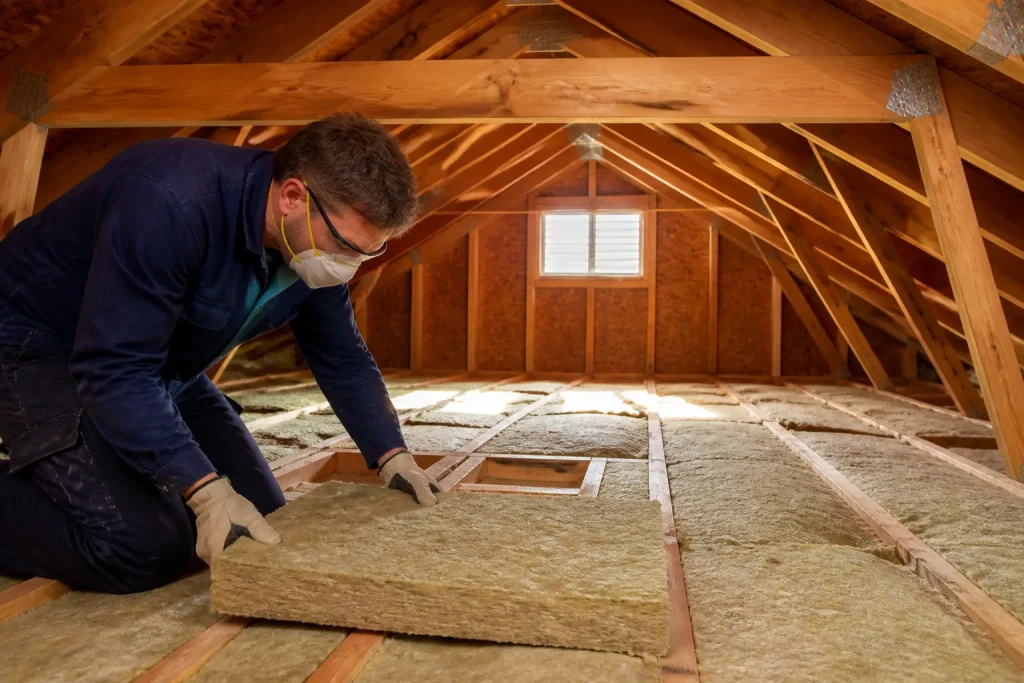
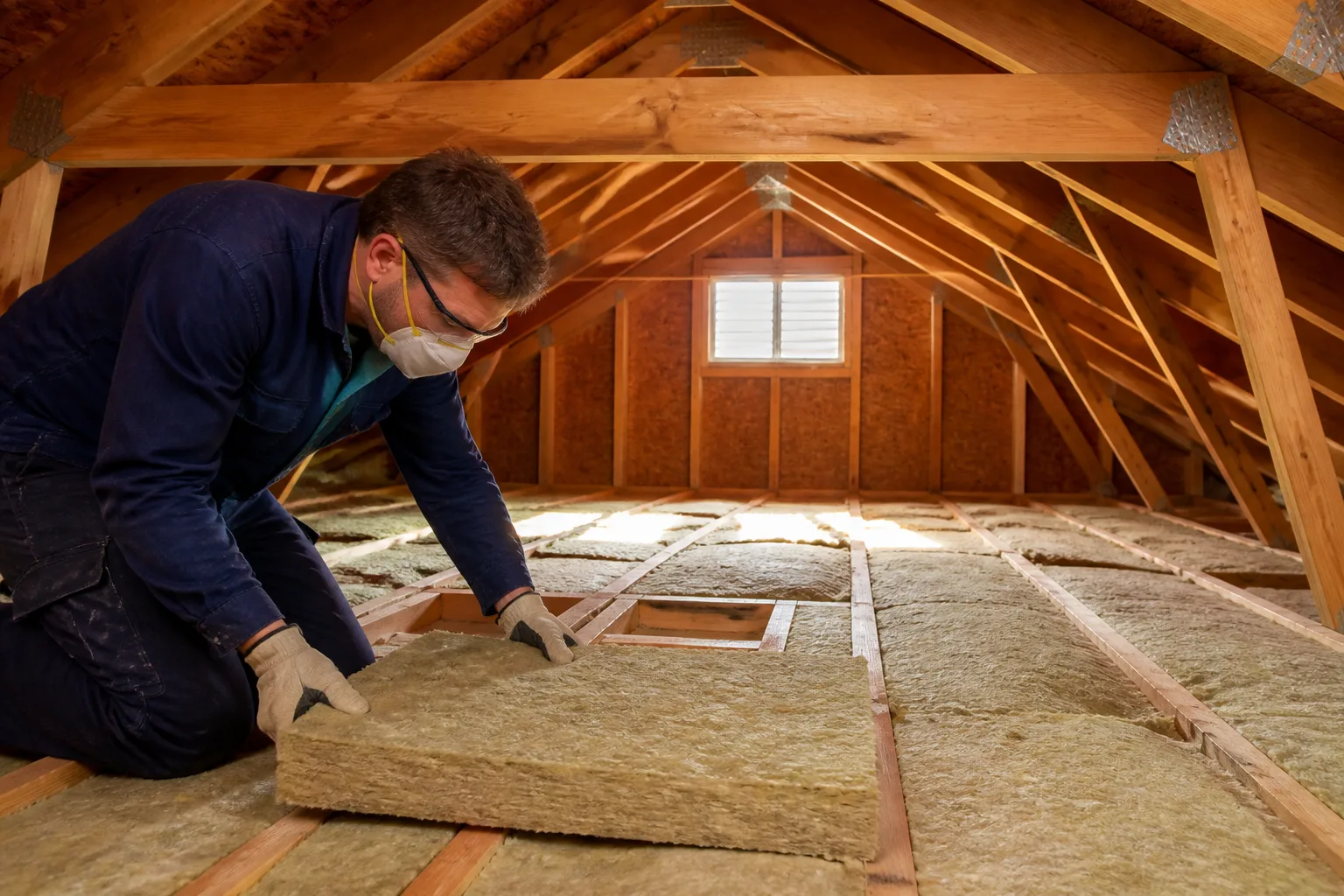
- Compression check. Rockwool batts must fill the cavity without being squeezed. Compression reduces R-value. If you can see the batt squished under wiring or squashed into a too-shallow bay, it’s wrong. Batts should be cut around obstructions, not pressed over them.
- Full coverage, no gaps. Walk or look the full attic. Every bay should be filled edge to edge. A one-inch gap along a top plate loses more heat than most people assume because air moves through the gap and bypasses the insulation entirely.
- Vapor management. Rockwool does not need a vapor barrier in Murrieta’s climate for most attic applications. If a contractor insists on stapling poly over Rockwool batts in an unconditioned attic, question it. Unfaced batts are standard; faced batts should orient correctly, and poly sheeting over attic floor insulation creates more problems than it solves in our climate.
- Manufacturer spec confirmation. Rockwool publishes installation guidelines for every product line. The contractor should be able to name the specific product installed (Comfortbatt, Safe’n’Sound, or Comfortboard) and show the R-value per inch from the manufacturer’s data sheet. Name-brand materials, installed to manufacturer spec, leave a paper trail.
We pulled Rockwool out of an attic off Clinton Keith Road last spring where a previous contractor had compressed Comfortbatt into 2×4 bays and called it R-15. It was performing closer to R-9. Installation errors with Rockwool are visible if you know what you’re looking at, and that’s exactly why a homeowner checklist matters.
Rockwool vs. Blown Fiberglass vs. Spray Foam in a Murrieta Attic
Here’s the comparison most Murrieta homeowners actually need when they call us. Three materials, what they cost, where they win, where they lose.
| Material | Installed Cost per Sq Ft | Best Application in Murrieta | Weak Point |
|---|---|---|---|
| Rockwool batts | $1.80 – $3.10 | Tile roofs, WUI-adjacent lots, cathedral ceilings, noise control | Cost per R-value, shallow bay fit |
| Blown fiberglass | $0.80 – $1.60 | Unconditioned attic floors with deep cavities, budget-driven projects | Air movement through material, moisture absorption |
| Spray foam (closed-cell) | $2.50 – $4.50 | Low-pitch roofs, unvented attic conversions, homes with HVAC in attic | Cost, installation sensitivity to temperature and humidity |
Blown-in, spray foam, or attic batts: Gallant installs all three, so the method chosen is the one that performs best here. Not the one we happen to carry. Not the one with the best margin. The one that matches your attic’s actual geometry, your roof’s material, and your home’s fire exposure.
Key Takeaways for Murrieta Homeowners Considering Rockwool
- Rockwool’s Class A fire rating is a practical safety consideration in Murrieta’s WUI zones, not just a specification line.
- The material’s density helps moderate attic temperature swings in our high-diurnal-shift climate, especially under tile roofs.
- Rockwool makes less sense in low-pitch roofs with shallow bays or when budget is the primary constraint on unconditioned attic floors.
- Moisture resistance gives Rockwool a real advantage in Murrieta’s tile-roof housing stock where condensation cycling is common.
- Poor installation negates the premium. Check for compression, gaps, and proper product specs before signing off.
Eight brands, one honest recommendation. Gallant Insulation Co stocks Rockwool alongside CertainTeed, Icynene, Demilec, and others, so the recommendation you get reflects your attic, not our inventory. If you’re ready to talk about your specific roofline, call (877) 265-0627. If you’re still researching, start with our Attic Insulation in Murrieta guide for a broader look at materials and methods, or compare options across our Spray Foam Insulation in Murrieta and Blown In Insulation in Murrieta pages. And if you want to see the full range of what we install, the Gallant Insulation Co home page breaks down all three methods and eight manufacturer lines.
The Bottom Line
Rockwool attic insulation in Murrieta makes the most sense for homeowners in WUI-adjacent neighborhoods, homes with tile roofs, and anyone who wants their insulation to do more than just slow heat transfer. It costs more than blown fiberglass, and in some attic configurations that premium is hard to justify. But if fire resistance, moisture handling, and thermal mass matter to your specific home, Rockwool is a material few Murrieta contractors stock, and fewer install correctly.
Gallant Insulation Co carries Rockwool as part of an eight-brand, three-method lineup, which means you get a recommendation based on your attic, not on what’s easiest for us to sell. If you’re in Murrieta and need help sorting through the options, we offer free estimates. Call (877) 265-0627 and we’ll walk the attic with you.
Frequently Asked Questions
For homes in Murrieta’s wildland-urban interface zones or with tile roofs, yes. Rockwool’s Class A fire rating and moisture resistance address risks that cheaper materials don’t. For a standard unconditioned attic floor in a composition-shingle home with no fire exposure, blown fiberglass delivers better cost per R-value. Call (877) 265-0627 and we’ll give you an honest comparison for your specific roof.
Yes, Rockwool batts can be DIY-installed in accessible attics since they cut cleanly with a serrated knife and friction-fit into joist bays. But Murrieta attics in summer reach dangerous temperatures, and navigating trusses over blown material is genuinely risky. We recommend a professional for anything involving deep retrofit work or hard-to-reach sections. If you’d rather not deal with it, estimates are free at (877) 265-0627.
Spray foam air-seals as it insulates, which Rockwool does not. That makes foam the better choice for unvented attic conversions or homes with HVAC equipment in the attic. Rockwool costs less per R-value than closed-cell foam and offers better fire performance. The right answer depends on whether your attic is vented or unvented, and where your ductwork lives.
Rockwool’s density makes it noticeably better at blocking airborne sound than fiberglass or cellulose. In Murrieta neighborhoods near the 15 or 215 freeways, that matters more than most insulation guides acknowledge. Safe’n’Sound is Rockwool’s dedicated acoustic product, but standard Comfortbatt also reduces exterior noise transmission meaningfully when installed in attic floor assemblies.
Written by the team at Gallant Insulation Co, serving Murrieta since 2014.
Need Insulation Help?
Call Gallant Insulation Co — licensed & insured, here with fast after-hours help in Murrieta.
(877) 265-0627